
Birman
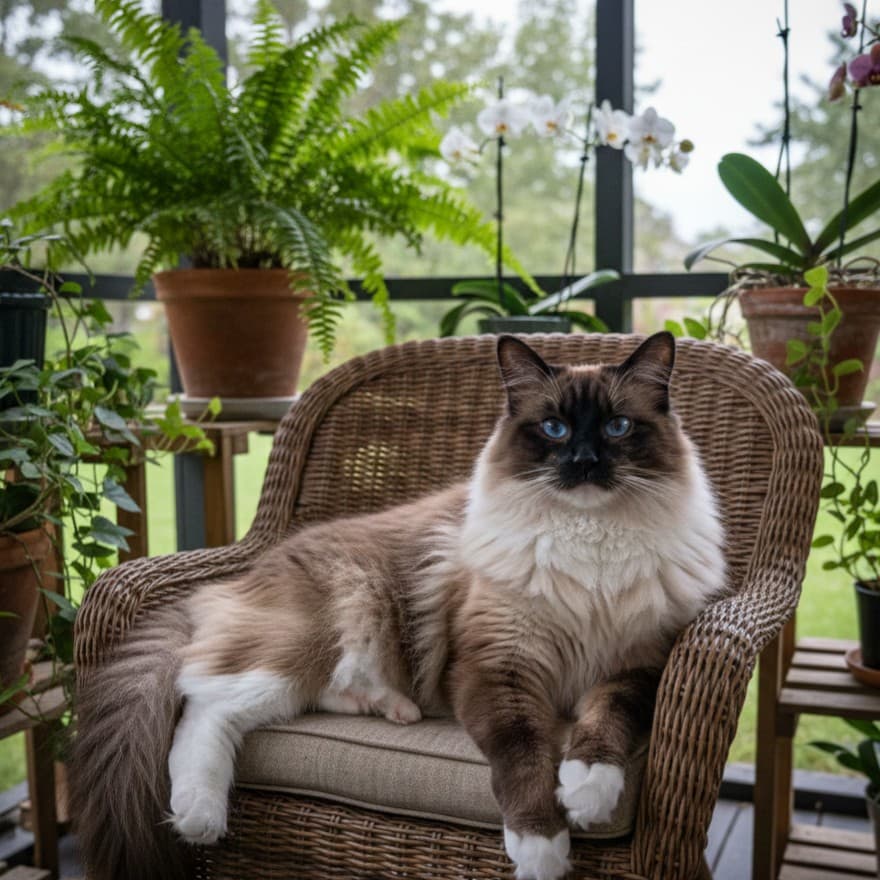
The Birman, also known as the Sacred Cat of Burma, is a gentle, affectionate longhaired breed with distinctive white-gloved paws and deep sapphire blue eyes. Known for their sweet temperament and unwavering devotion to their families, Birmans are often called 'Velcro cats' for their endearing tendency to follow their owners everywhere throughout the house. Birmans combine striking beauty with an exceptionally easygoing personality, making them one of the most popular companion cat breeds worldwide. Their patient, tolerant nature makes them ideal for families with children, while their moderate exercise needs and easy grooming requirements appeal to first-time cat owners. Their calm demeanor and quiet voices ensure they fit comfortably into virtually any household environment.
Key Stats
Weight
6-15 lbs
Height
8-10"
Lifespan
13-15 yrs
Energy
3/5
Is This Breed Right For You?
Origin & History
Birman origins are steeped in legend and mystery, with the breed said to have originated as sacred temple cats in Burma, now Myanmar. According to the most popular legend, Birmans were the companions of Kittah priests, and their distinctive white paws symbolize purity. While the romantic stories are captivating, the documented history of the breed begins in Europe in the early twentieth century.
The first Birmans are believed to have arrived in France around 1919, either as gifts from grateful temple priests or through more conventional means. Auguste Pavie, a French explorer, and Major Gordon Russell are both credited in various accounts with bringing the original cats to France. Whatever the circumstances, a breeding pair established the foundation of the European Birman population.
The breed faced near extinction during World War II. By the war's end, only a single breeding pair survived in all of Europe. French breeders undertook a painstaking reconstruction of the breed through careful outcrossing with Persians and Siamese, working to maintain the distinctive white gloves, pointed coloration, and gentle temperament that defined the Birman. This rebuilding effort required many generations of selective breeding.
The Birman gained formal recognition in France in 1925 and gradually spread across Europe. CFA accepted the breed for registration in 1967, and TICA followed with recognition in 1979. Today, the Birman is beloved worldwide, consistently ranking among the most popular cat breeds in registries across Europe, North America, and Australia. Their combination of striking beauty and gentle temperament continues to win new admirers.
Traits & Characteristics
Individual cats may vary from breed-typical traits
Family & Social
Personality
Cattitude
Adaptability
Health & Wellness
Key health information for Birman owners
Health Screening
- Hip & Elbow Evaluation
- Cardiac Exam
- Eye Certification
Exercise Needs
- 20+ minutes daily
- Mental stimulation important
- Moderate activity
Watch For
- Polycystic Kidney Disease (PKD)
- Obesity
- Hypertrophic Cardiomyopathy (HCM)
Care Guide
Everything you need to know about caring for a Birman
Grooming
weekly
Exercise
20+ min/day
Training
Very Easy
Health
Generally Good
Training Your Birman
Training Approach
Use positive reinforcement with treats and praise. They respond well to gentle, patient training. Keep sessions engaging.
Training Tips
- Can learn tricks and commands
- Respond well to their name
- Enjoy interactive puzzle toys
- May enjoy fetch games
Common Challenges
- Can be territorial - may need training around other pets
- May be stubborn if not interested
- Prefer calm training environments
Is a Birman Right For You?
Great Match If...
- You have children or a family
- You want an easy-to-train cat
- You're active and outdoorsy
- You want a loyal companion
Think Twice If...
- You're away from home often
Frequently Asked Questions
Birman cats have distinctive pure white 'gloves' covering all four paws, which are one of the breed's most recognizable and defining characteristics, steeped in legend about sacred temple cats of Burma. On the front paws, the white forms an even, symmetrical line across the top of the paw, creating the appearance of neatly fitted mittens. Judges evaluate the evenness and symmetry of these lines carefully in the show ring.
On the back legs, the white markings extend further up the back of the leg in a distinctive pointed pattern called 'laces,' which ideally come to an inverted V shape below the hock. These laces are unique to the Birman breed and add to their elegant appearance. Achieving perfectly symmetrical gloves and laces is one of the most challenging aspects of Birman breeding, as the white spotting gene that produces them can be unpredictable.
These white markings are required for show quality cats and are the feature that most readily distinguishes Birmans from other pointed longhaired breeds like Ragdolls and Himalayans. The gloves develop alongside the point colors as kittens mature, becoming increasingly distinct as the surrounding darker color fills in against the pure white paws.